
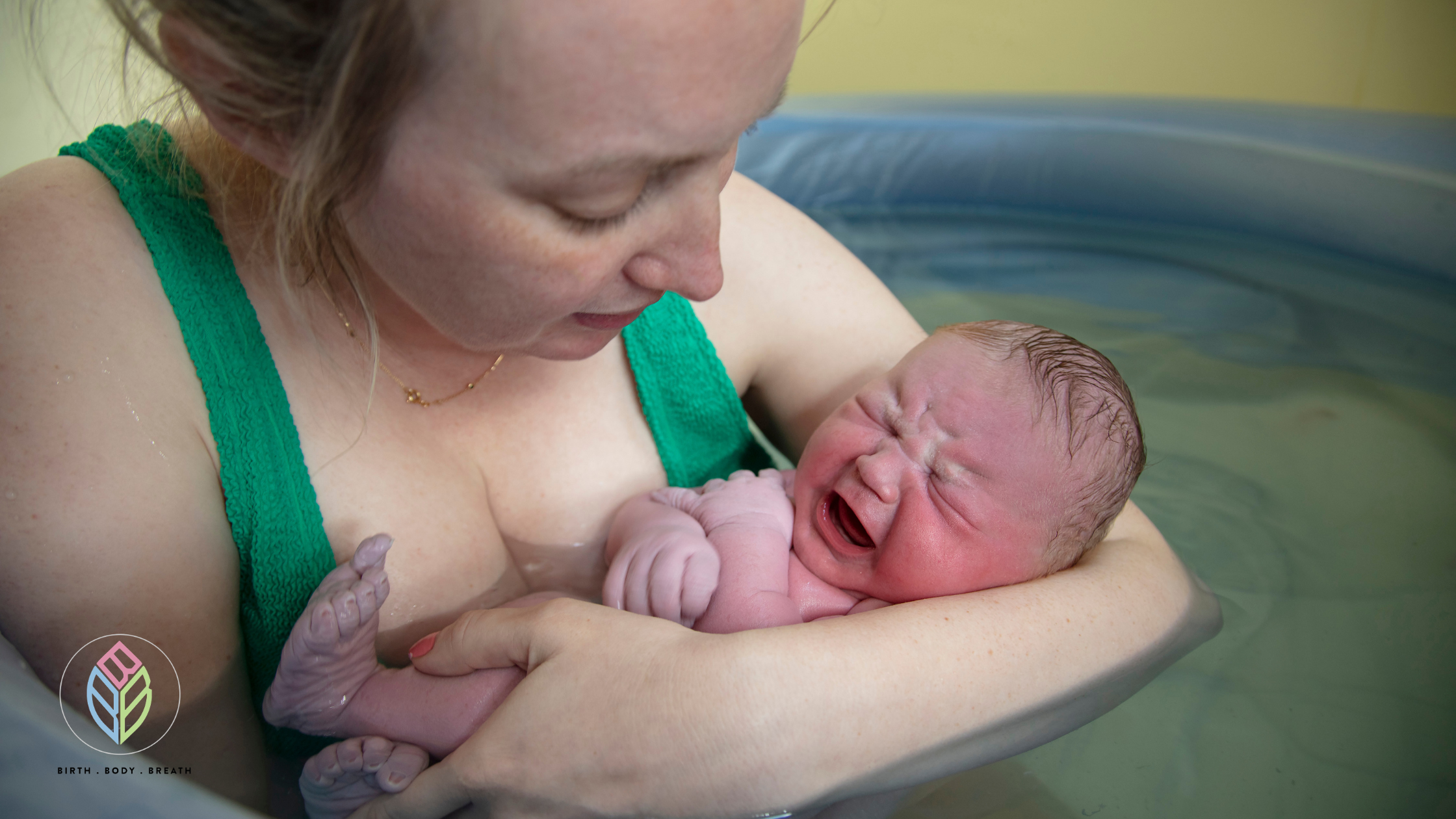
Water Birth in Bristol: Is Pool Availability Really the Problem?
I work with tens of pregnant women every month, as a doula in Bristol, a Hypnobirthing teacher and a pregnancy yoga facilitator, and water birth is consistently something many of them are interested in exploring. It’s not hard to understand why. It’s well known that using water in your labour can improve your comfort and reduce your reliance on pharmacological pain relief.
Studies have shown it can reduce the use of other interventions in your birth, including artificial oxytocin drips, and it also reduces your chance of experiencing a tear. I don’t need to refer you to a research study though to help you understand that water can improve your mobility during labour – it’s just common sense! If you’ve been swimming in your pregnancy you’ll already get that completely; the wonderful sensation of weightlessness and support that water offers is such a relief in those final weeks of pregnancy!
Most antenatal education courses will talk about all these benefits of water in birth and maybe even feel like they encourage you to plan to use a birth pool, or at least have one in your birth environment to access should you want to take a dip on the birthing day. They’ll likely warn you that so many women want access to a birth pool that there’s a chance you might not get it because the birth pool rooms might be busy – this is probably the most common worry people share with me when discussing their plans to use a birth pool.
So, many pregnant women are keen to have access to water in their birth and even being encouraged to plan for it… but are they getting it?
How Many People Get to Have a Water Birth in Bristol?
Let’s cut to the chase. Many pregnant women want to access water in their birth – but not many are getting it.
Southmead Hospital shares its maternity statistics publicly, so let’s look at the numbers and see what they can tell us.
In June 2026, 473 babies were born under NBT (Southmead Hospital and the homebirth areas it covers). Only 25 women used the birth pool in their labour.
This works out at only 5.3% of people accessing the birth pool. Or 1 in 19 births.
And note, on Southmead Hospital’s infographic, this clearly says ‘Birth Pool Used’ – so this appears to be the total pool usage. Less than 25 babies are likely to have been actually born in the water – or the heading would read ‘Babies born in Water’ as Bath RUH display on their infographic.
In case you’re wondering if this was just an unusual month for some reason, this trend is similar over time. In July 2026, 29 people used the birth pool (not necessarily had a water birth) out of 509 births, or 5.6%, and in August, just 20 out of 451, or 4.4%.
It’s not entirely clear from the way information is shared on the infographic, but this possibly includes the few home births, as well as they are captured in the total birth data.
Unfortunately, St Michael’s Hospital are still not sharing their maternity statistics freely so it’s not possible to draw up to date evidence-based conclusions about access to water there, but it’s likely to be very similar, from historical data that’s been shared.
Is Bristol Short of Birthing Pools?
At first glance, it would be easy to assume that the reason so few people are using the pools is that there simply aren’t enough of them. But let’s consider that argument…
The Problem Is Not the Number of Pools
At Southmead Hospital Hospital, there are 3 birth pools available on Mendip Birth Centre, the attached midwife led unit, and there is one available on the Central Delivery Suite (CDS) as well. So there 4 possible birth pools to use.
It seems highly unlikely to me that if just 20-30 people a month are using birth pools that the problem is the birth pools are busy! It averages out at 1 person a day, or less, accessing the birth pools.
Of course, it’s unlikely the people who are using the pool just happen to line up in an orderly manner and come in one day at a time! It is possible that 2 or perhaps 3 people might want to use a birth pool at the same time. But there is capacity for the hospital to offer this.
Common sense tells me that if only 20 people are using the birth pool in a month, it’s unlikely there’s a day when all 4 are occupied and a fifth person is unable to access one. If this does arise, it’s going to be extremely rare, rather than the norm.
Is Southmead Hospital Hospital the Problem Then?
St Michael’s Hospital has 2 birth pools on its Midwife Led Centre and another in Room 7 on the Central Delivery Suite. But again, as they’re not sharing any maternity service information it’s impossible to make any clear judgement on what might be happening there.
Bath RUH does share their monthly statistics and we see a similar picture there. They don’t have a specific MLU at Bath but do have 2 pool rooms available, and the data also covers Frome and Chippenham freestanding MLUs that have pools available too. In July 2026, 356 babies were born and 13 were ‘born in water’. (Note: with that language, it’s possible more people accessed water but only babies actually born in it were recorded on the infographic). This is a rate of 3.6%.
And the picture is similar in other parts of the country too. In West Hertfordshire, the rate was just 2% in July and in Airedale, out of 159 births, 0 were in water.
The Bigger Question: Why Are the Birth Pools Not Being Used?
The data alone cannot give us the definite answer to this question. But we can use it to make some likely assumptions.
Roughly 90% of people are giving birth on the Central Delivery Suite at Southmead Hospital each month (based on June-August 2026 data, though this is also pretty consistent across time) and remember there’s only one pool here.
Logic suggests that with only one pool available and the majority of pregnant people birthing here, it’s more likely that it will be occupied when you want to access it, compared with the MLU where there are 3 (and only 7-10% of people birthing). It’s possible that does happen – though again, seems unlikely when we look at the total number of people using a pool.
Most people (though not all) giving birth on the Central Delivery Suite will have been told they need to give birth here, for multiple reasons. Because of monitoring requirements from hospital policies, risk labels that have been attached in pregnancy, or pre-existing concerns about the baby’s well-being after birth. Some of those people will also have been told water is not an advisable option for their birth, or even have it presented as an option, for the same reasons.
Some people who are choosing to birth on the MLU will also be told that using water is inadvisable for their labour or birth – for instance, if a mother develops a high temperature, she will be asked to exit the water.
Around 30% of labours are induced at Southmead Hospital and this may have an impact on your access to water – we’ll look at this more below.
Southmead Hospital has stopped separating out planned caesareans from emergency caesareans in their data, but currently we usually see around 20% of births are planned caesareans. Obviously for those births, using water is not an option.
Some of the caesarean births that happen after labour has started, water may have been used earlier on in the labour before a caesarean birth was recommended.
Looking at the data in this way, it seems reasonable to assume that the way pregnancies and births are managed is more likely to be affecting access to water than the availability of pools.
Does “High Risk” Automatically Mean You Can’t Use a Birth Pool?
This is a more complex question! In short… no. A high risk label doesn’t automatically mean you can’t use a birth pool.
It’s important to understand that not all risk labels are equal. You can have a high risk label because you have a serious medical condition, such as pre-eclampsia, which can be a life-threatening illness for the mother. You can also have a high risk label attached to your pregnancy for a “soft” reason, because you have a high BMI for instance. This isn’t necessarily a problem in and of itself, and having a high-risk label doesn’t automatically mean that birth will work differently.
However, a high risk label of any kind often means that different policies are activated and different recommendations are made. Some of those are of course logical and evidence-based, but, surprisingly, many are not.
For instance, in the case of BMI there is no evidence that a water birth would increase adverse outcomes for a larger bodied person or their baby. It’s actually very logical to assume that water would support a smoother birth, in fact.
When I’ve been supporting people as their doula in Bristol, I have heard ‘soft’ risks used to rule out a birthing person’s access to water, and the removal of this provision stated as a fact to expectant mothers.
For example, one mother I was supporting was told she was not allowed to use the pool on CDS because her BMI was too high. A higher BMI can be associated with additional pregnancy and birth risks, but that is a different question from whether BMI alone makes using a birth pool unsafe. People are being told they can’t have access to water because of ‘risk’ but there’s no evidence water CHANGES the perceived risk.
It’s really vital that you understand what risk labels you might be carrying through the maternity system and what they mean for your care – but even more importantly, what they actually mean in reality for you and your baby. You may be surprised to discover you have a risk label but there’s not actually any evidence that it will create a problem at all, that the risk is significant, or that water specifically would increase the chance of any undesirable outcome.
If using water doesn’t change the level of risk, (and in fact, even if it does!) it should be up to the birthing person to decide what is right for them. Your body, your baby, your choice.
Can I Use the Birth Pool if I’m Having an Induction?
This is a really important consideration, because many people will accept an induction of labour – typically around 30% each month at Southmead Hospital. As a doula in Bristol, I know that induction often arises as a serious consideration towards the end of pregnancy – just when you had been planning for a ‘normal’ birth and probably even hoping for water.
I have supported a doula client who decided to accept an induction and water birth was, dare I say it, dangled as a carrot to encourage her to accept that, but that assurance did not materialise on the day.
Does Induction Rule Out a Water Birth?
In theory, induction doesn’t rule out access to water. The NHS website itself states “You should have access to all the pain relief options usually available, such as an epidural or water birth”(1).
So, induction does not necessarily rule out water birth in principle. But in practice, it can make accessing a pool much more difficult.
Because your labour is being artificially started, extra risks are introduced to your baby (these are well documented and researched, though not always well communicated). Therefore, extra monitoring is advised. It’s possible to use waterproof wireless heart rate monitoring so again, in theory, this doesn’t rule the pool out. However, induction will always take place on the CDU and that does mean you have to hope the single pool room is available and that the staff ‘let you’ have it if it is free.
More than just additional monitoring though, induction is a process. Without skilled advocacy and support, most people don’t realise just what that process entails. It can take several days and will begin on a ward, before then transferring to CDU. It’s common to move to a CDU room for the next steps of the induction process but before labour has officially begun and if your labour hasn’t started, you wont be granted access to that single pool room simply because you aren’t even in labour, let alone being in a position to use the pool yet.
In my experience as a doula, the pool room on CDU is reserved for those who are most ‘low risk’ and not offered to those undergoing the induction process.
How Can I Improve My Chances of Accessing Water
If accessing water is important to you in your birth, it’s essential that you plan for this. Common advice is to ‘speak to your midwife’ in pregnancy – this certainly won’t do any harm, but it won’t go any way to ensuring you can access it. Your community midwife cannot reserve you a pool room nor will she be at your birth to support you in accessing it.
How to Ensure You Have Access to a Birth Pool
I’m going to be brutally honest here. The only way you can guarantee that a pool will be available to you is to plan a home birth.
You can buy, or hire, your own pool and it will definitely be there.
You have 100% chance of it being available!
You can choose to get in it to support early labour, or even just to bob around at the end of pregnancy, like a massive bath.
You might not want to get in it, or your birth might go so smoothly there’s no time to get in it, but you know it’s there for you should you want it.
Your access to the MLU can be denied based on your risk label, but despite popular belief, you absolutely can plan a home birth if you have a high risk label and the NHS has a duty of care to support that.
Consider How Else You Can Utilise Water
If home birth doesn’t feel right for you personally, it’s worth spending some time considering how else you can make use of water in your labour and birth.
A birth pool isn’t the only option for harnessing the benefits of water – you might like to have a bath at home in early labour, or make use of the shower. Most of the CDU rooms at Southmead Hospital have attached bathrooms with showers so this can still be an option at hospital. Cold flannels and hot water bottles are also really useful ways to use water, and obviously drinking plenty of it too!
These might be your preferred ways of using water, or they might be your plan B if you aren’t able to access a birth pool room.
If You Want a Water Birth in Bristol, What Should You Ask Your Midwife?
As I mentioned, just asking your midwife at your pregnancy appointments if you can have a water birth is likely to have no impact on your actual birth experience. But there are some things you can ask her, or any consultants you’re dealing with, that can help you decide what’s right for you and your baby.
- Am I considered low or high risk, and why?
- Is there anything about my circumstances specifically that affects access to the pool?
- Is it the water itself that’s considered unsuitable, where’s the evidence for this?
- Does the monitoring/care youre recommending change my plans to use water?
- If I need continuous monitoring, is waterproof or wireless monitoring available?
- What does your local policy say about my circumstances?
- If I’m not eligible for the MLU, does that automatically mean I can’t use a pool?
- If I decide to plan a home birth, how will you support that?
Southmead Hospital have an excellent Birth Choices service where you can have a detailed and personalised conversation if you are asking for support with an ‘outside of guidance’ birth. If you are being denied access to the MLU they are worth speaking to because there may be plans that can be put in place to better support you as an individual.
St Michael’s MLU is more risk adverse so if you are being denied access here, know that you also have options: you can consider changing hospital to switch to Southmead Hospital, you can speak to both the Birth Options team at St Michael’s and to the Birth Choices team at Southmead Hospital to explore your care plan.
So, What Are Your Chances of a Water Birth in Bristol?
The chance of being able to access water in birth is low across all areas of the country, despite plenty of research showing its benefits.
There’s a host of reasons why accessing water can be more difficult (in other words, less well supported!) and many of them aren’t justified.
In terms of your actual chance of accessing water, this will depend, in part, on how your unique pregnancy is going, but also on the questions you ask and the choices you make.
If you want support navigating your birth choices and exploring what’s right for you, that’s exactly what I help my doula clients with. I’ve supported births at Southmead Hospital, St Michael’s, Bath RUH and further afield, as well as at home, too, of course. Read more about my doula support here.
Kim ❤️
Further useful reading:
- https://www.nhs.uk/pregnancy/labour-and-birth/inducing-labour/ NHS guidance on inducing labour.
- https://bmjopen.bmj.com/content/12/7/e056517 A 2022 review of Water Birth safety, Burns et al.
- https://obgyn.onlinelibrary.wiley.com/doi/10.1111/1471-0528.17878 The 2024 POOL Study
- https://www.sarawickham.com/research-updates/more-benefits-of-water-for-birth/ Sara Wickham blog – the benefits of water birth.

